The price of fire: Why Kenya's charcoal crisis is everyone's problem
By Jadiel Guantai, Senior Investment Manager, Energise Africa, Nairobi
I live and work in Nairobi. And every morning, before I open my laptop, I can smell the city waking up.
It's the smell of charcoal (commonly known as ‘makaa’ in Swahili) smoke - heavy blue smoke, and right now, it's costing people more than they can afford.
Charcoal prices in Kenya have hit a five-year high, placing a heavy burden on millions of low-income households that depend on it as their primary cooking fuel. And that might be the woman in Mathare who is skipping meals to afford fuel to cook the ones she does make, or a father in Mukuru who is spending a growing share of his income just to heat water. Many street-food vendors (locally known as ‘vibandaski’), who mainly rely on charcoal for cooking, are becoming frustrated by squeezed margins.
The numbers are scary.
A standard 90kg sack of charcoal in major Nairobi markets like Gikomba or Eastlands now ranges from 1,800 to 2,800 Kenyan shillings, and that's before it reaches your door. At retail, charcoal trades between 35 and 70 shillings per kilogram, with prices creeping upward as supply tightens. For a household that might burn through a sack every few weeks, this is no minor inconvenience but a genuine crisis eating into food, school fees and healthcare budgets.
Why is supply tightening?
Reduced access to forests, transport restrictions and enforcement measures aimed at protecting the environment have squeezed supply, while rapid urbanisation and population growth continue to push demand higher. It is the worst of both worlds: harder to get, more expensive to buy, and the people bearing the cost are those who can least absorb it.
And the worst part of it is this: charcoal is not even a good solution. It is dirty, inefficient, and it is making people sick. Heavy charcoal use accelerates deforestation, increases health risks from indoor air pollution, and works against climate goals because inefficient biomass burning produces significant greenhouse gas emissions. The prices of other locally popular alternatives, such as LPG and kerosene, are rising due to current events in the Middle East. Families are paying through the nose for a fuel that damages their lungs, strips their forests and heats the planet. There is nothing about this that is acceptable. I think about this often, and it is why, when I look at what EcoSafi is doing, I feel excitement and pride.
Enter EcoSafi.
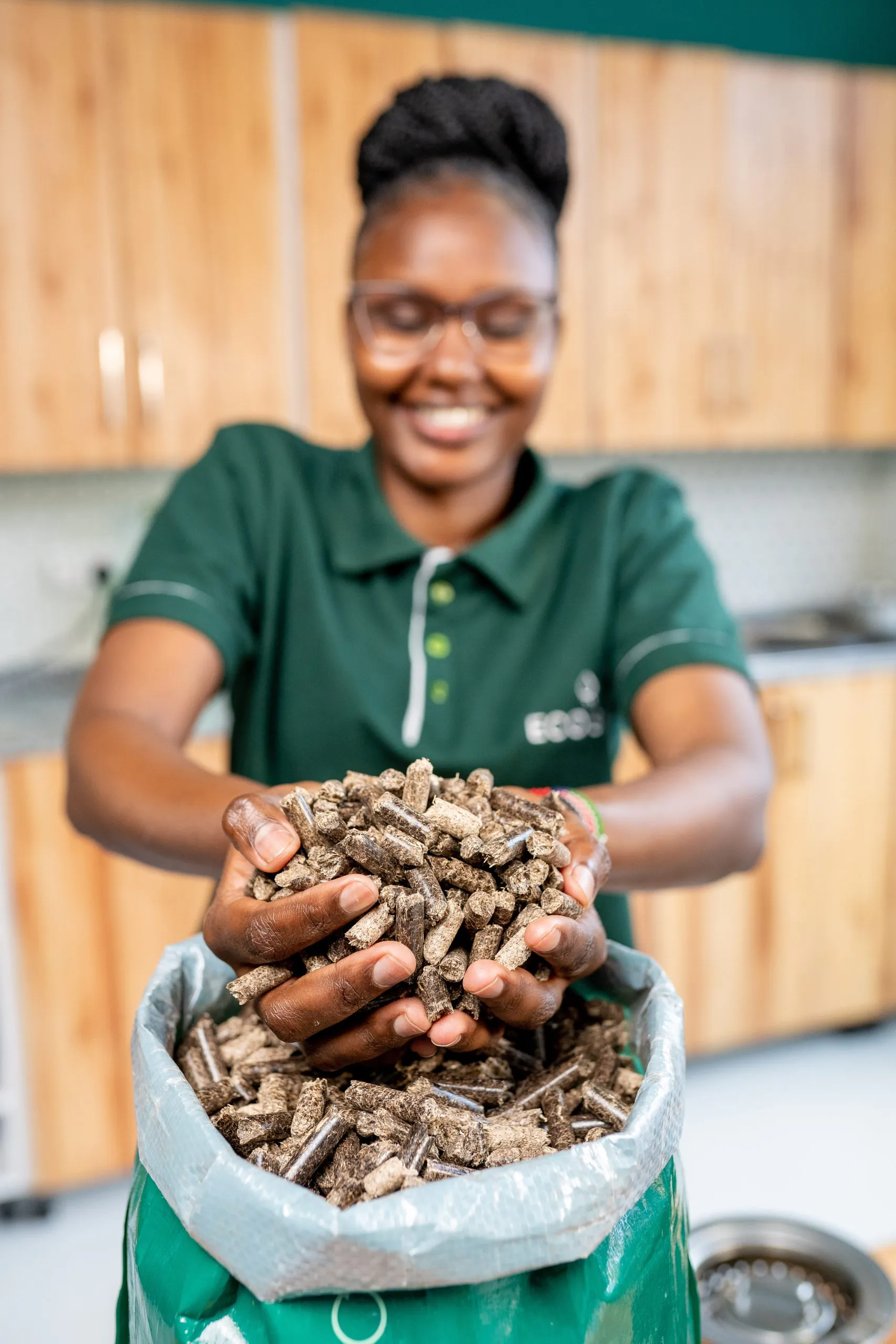
EcoSafi is a Kenyan clean-cooking company doing something different. Rather than asking low-income families to make a leap of faith and buy an expensive new stove, EcoSafi provides households with its proprietary, efficient gasification stove free of charge, EcoSafi also manufactures the fuel itself: sustainably produced pellets made from agricultural waste, and supplies it directly to customers at prices 40 to 70% cheaper than charcoal or LPG.
The stove and the fuel are a lock-and-key system: the stove is engineered to burn EcoSafi’s pellets, and the pellets are designed to combust cleanly in the stove.
That’s right, they are offering cleaner cooking, better performance, dramatically lower costs and no upfront barrier.
Additionally, because the pellets are produced locally, users are not exposed to international geopolitical risks, and the country saves on foreign currency. The pellets burn hotter, faster, and cleaner than charcoal, so clean, in fact, that EcoSafi’s stove falls into the same WHO Tier 5 category for particulate emissions as LPG and electric cooking.
As far as EcoSafi is aware, they are currently the only biomass stove company in the world achieving that standard. Clean cookstove users avoid the smoke exposure that comes with traditional charcoal stoves entirely. For women and children who bear the health burden of indoor air pollution most acutely, this solution makes a huge difference.
The Ecosafi bond offer on Energise Africa is raising £300,000 to fund the manufacture and distribution of nearly 5,000 clean cookstoves and their associated fuel pellets. The projected impact over the lifetime of those stoves is striking: 37,673 tonnes of CO₂ saved, 61 hours saved per household annually, and over £310,000 in collective fuel savings for the families reached by this bond alone. That's nearly five thousand families no longer trapped in the charcoal cycle, breathing cleaner air, spending less on cooking, and freed from the daily anxiety of whether they can afford to make dinner tonight.
EcoSafi's cook stoves are a solution to a problem that’s here, real, and worsening. The solution is scalable, proven, and already working. EcoSafi has achieved global recognition for issuing Africa's first Gold Standard metered clean cooking carbon credits, earning top-tier independent ratings for quality and integrity. They are a company with credibility, a compelling model, and a clear mission.
The bond targets an 8% annual return over a 24-month term, with a minimum investment of just £50. It can be held within a tax-efficient Innovative Finance ISA. But for me, the return that matters most is the families who no longer have to choose between eating and cooking.
If you're reading this in the UK, the distance between you and a charcoal-burning kitchen in Nairobi can feel vast. It isn't. A modest investment today will connect you directly to a family switching off a charcoal stove.
The whole Energise Africa team and I believe in what EcoSafi is building. I've seen the problem they're solving up close and think this is one of the most impactful investments we have offered on the platform. Explore the EcoSafi bond offer on Energise Africa https://www.energiseafrica.com/invest/ecosafi-issue-1-8-0-bond